

Last updated: November 2026
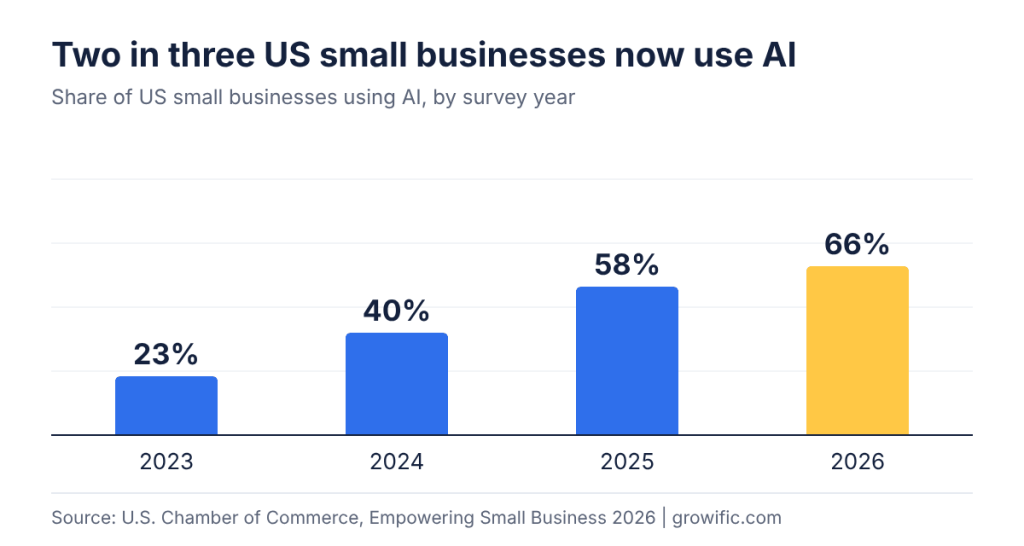
Two out of three US small businesses now use AI, almost three times the share in 2023. Yet the US Census Bureau puts the figure closer to one in five. Both numbers are real, and the gap between them tells you a lot about where small businesses really are with AI.
This page collects the most useful small business AI statistics in one place: adoption, use cases, time saved, costs, jobs, barriers and how customers now use AI to find local businesses. It is built for owners making decisions and for writers who need a number they can trust.
Every statistic links to its original source, such as the US Census Bureau, Eurostat, the Federal Reserve and the US Chamber of Commerce. We opened and checked each one in November 2026, and we explain where surveys disagree instead of hiding it.
$250
a month: the median AI bill for small businesses that pay for AI
Key findings
- 66% of US small businesses used AI in 2026, up from 58% in 2025 and 23% in 2023 (U.S. Chamber of Commerce, 2026).
- 19.8% of all US businesses were using AI as of May 2026, according to government data that samples every type of firm (US Census Bureau, 2026).
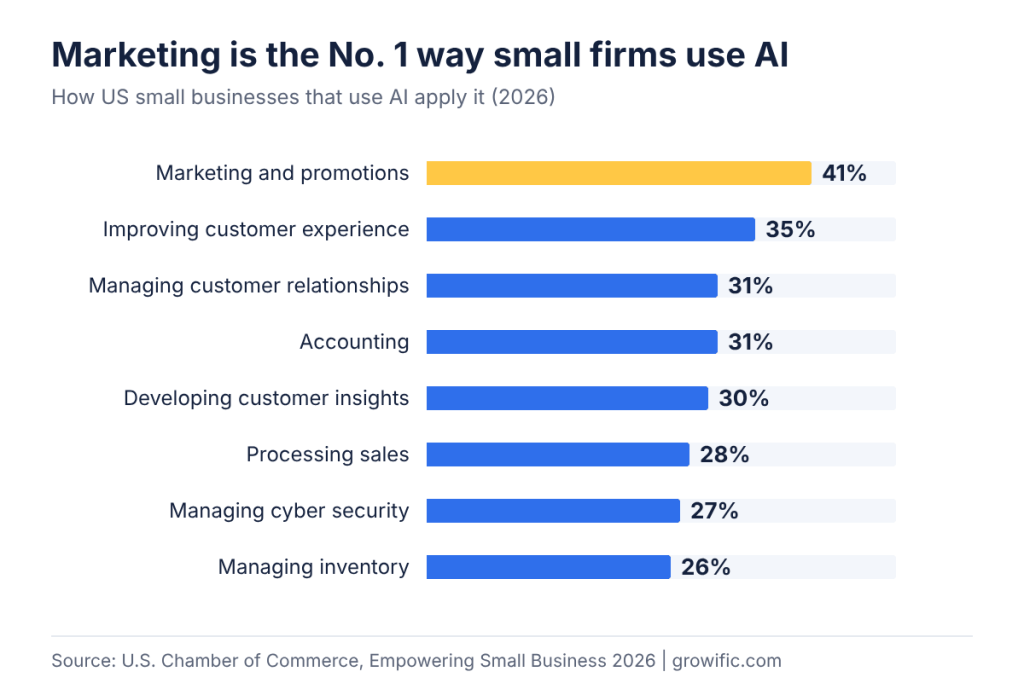
- 41% of US small businesses that use AI apply it to marketing and promotions, the most common use in 2026 (U.S. Chamber of Commerce, 2026).
- Small business owners save a median of 5 hours a week with AI, and their teams save another 11.5 hours (SBE Council, 2026).
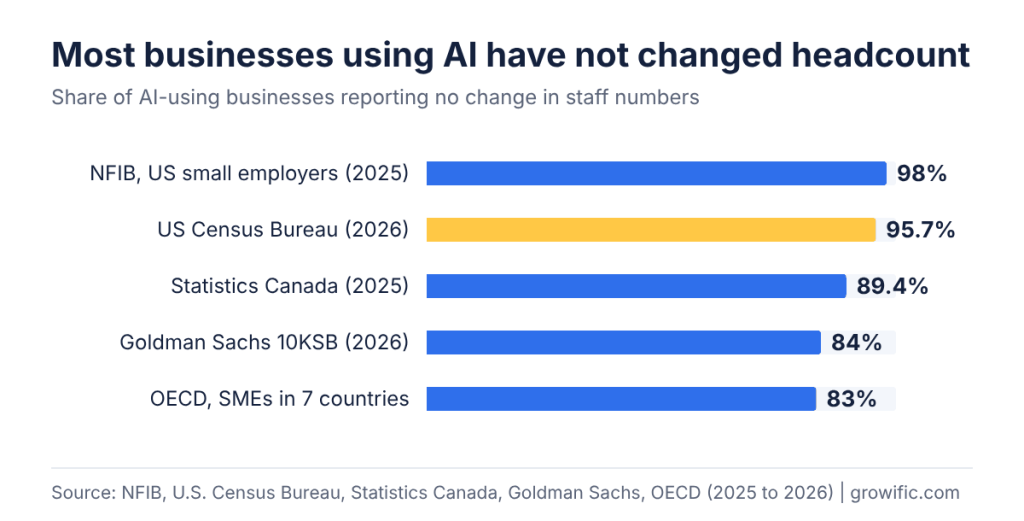
- 95.7% of US firms using AI reported no AI-driven change in employment over six months in early 2026 (US Census Bureau, 2026).
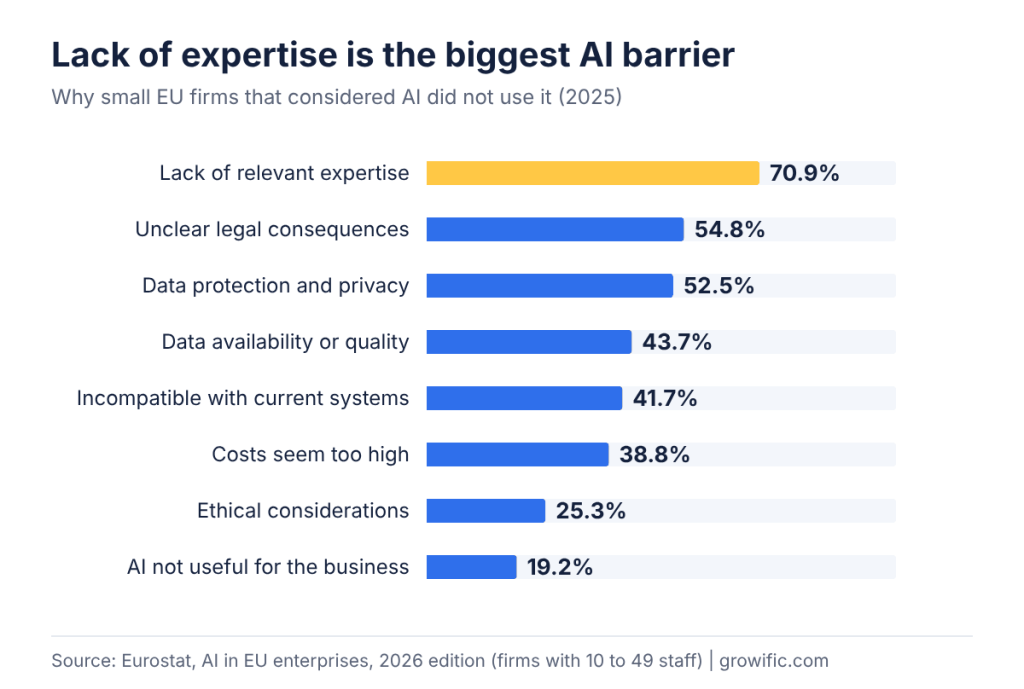
- 70.9% of small EU firms that considered AI but did not adopt it said a lack of expertise held them back in 2025 (Eurostat, 2026).
- 45% of US consumers used AI tools to get local business recommendations in 2026, up from 6% a year earlier (BrightLocal, 2026).
Jump to a section
- How Many Small Businesses Use AI?
- Why AI Adoption Numbers Disagree
- Small Business AI Adoption Around the World
- How Small Businesses Use AI
- AI Results: Time Saved, Revenue and ROI
- What Small Businesses Spend on AI
- AI and Small Business Jobs
- Barriers: Why Small Businesses Hold Back
- AI in Marketing and Customer Service
- How Customers Find Businesses With AI
- Methodology and Sources
- FAQs
How Many Small Businesses Use AI?
These are the headline adoption numbers for US small businesses, from the largest recurring surveys.
- 66% of US small businesses used AI in 2026, up 8 points from 2025, in a survey of 3,732 firms with fewer than 250 employees (U.S. Chamber of Commerce, 2026).
- 23% to 66%: small business AI use in the US Chamber survey nearly tripled between 2023 and 2026, passing 40% in 2024 and 58% in 2025 (U.S. Chamber of Commerce, 2026).
- 41% of US small businesses used a generative AI chatbot such as ChatGPT, Gemini or Claude in 2026, while 24% used an agentic AI tool (U.S. Chamber of Commerce, 2026).
- 19.8% of US businesses reported using AI as of May 3, 2026, and the national rate stayed between 17% and 20% from December 2025 to May 2026 (US Census Bureau, 2026).
- Less than 20% of US firms with four or fewer employees reported using AI in 2026, compared with 37% of firms with at least 250 employees (US Census Bureau, 2026).
- 3.9% of US businesses used AI to produce goods or services in late 2023, under an older and narrower Census question (US Census Bureau, 2023).
- 18% of US firms used AI in a business function between November 2025 and January 2026, and that share was expected to reach 22% within six months (US Census Bureau, 2026).
- 46% of US small employer firms said their business or employees used AI in late 2025, and another 15% planned to start within 12 months (Federal Reserve Small Business Credit Survey, 2026).
- 7% of US small employer firms using AI had fully integrated it into their business in late 2025, while about half were still experimenting (Federal Reserve, 2026).
- 77% of US small and midsize businesses used AI regularly in January 2026, up from 48% in July 2024, counting free tools and built-in features (Intuit QuickBooks, 2026).
- 82% of US small business employers had adopted at least one AI tool in February 2026, and the typical small business used five different AI tools (SBE Council, 2026).
- 66% of US small and midsize businesses had adopted AI by April 2026, up from 55% a year earlier (Thryv, 2026).
- 86% of Goldman Sachs 10,000 Small Businesses graduates used AI in August 2026, up from 56% in July 2024 (Goldman Sachs, 2026).
- 24% of US small business owners said they used AI tools such as ChatGPT, Grammarly or Canva in March 2025 (NFIB, 2025).
What this means for you
AI is now a normal small business tool, not an experiment. If you are not using it yet, you are in a shrinking group, but most owners are still early too: only 7% of AI users have fully built it into how they work.
Why AI Adoption Numbers Disagree
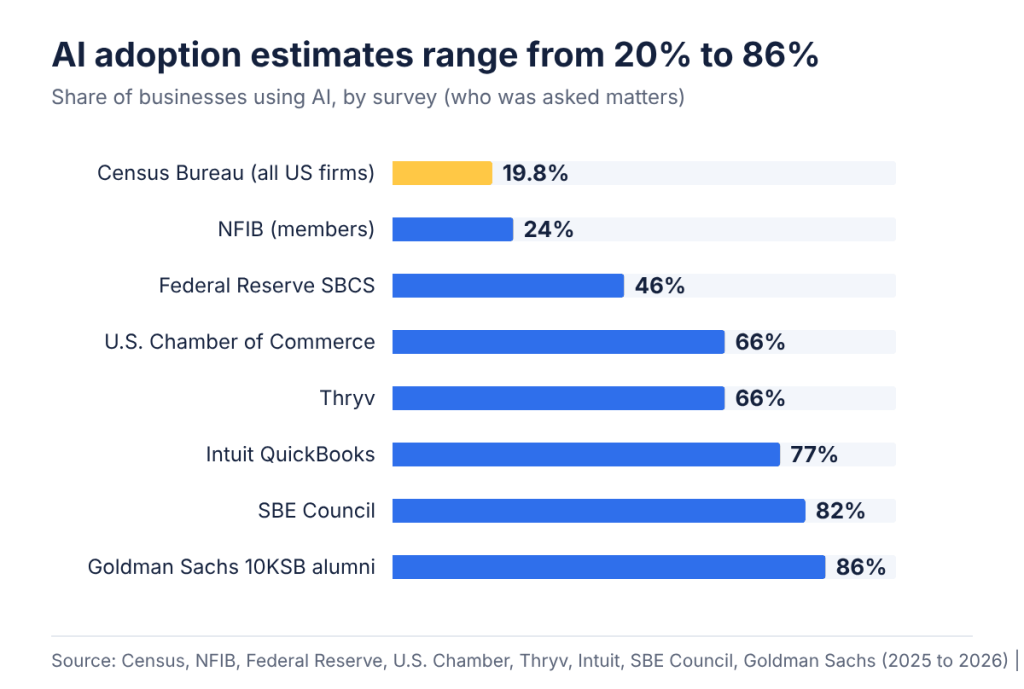
You will see small business AI adoption quoted anywhere from about 20% to over 80%. The gap comes from who is asked and how the question is worded, not from bad data.
- Government surveys (Census Bureau, Statistics Canada) sample all kinds of firms, including many very small ones that never think about AI, and ask about use in a recent period. They come in lowest.
- Industry and vendor surveys (Intuit, Thryv, SBE Council, Goldman Sachs) often survey their own customers, members or program graduates, and count any use of a free chatbot. They come in highest.
- The question matters. In late 2025 the Census Bureau changed its question from AI “in producing goods or services” to AI in “any business function”, so 2023 and 2026 Census figures are not directly comparable.
| Survey | Who was asked | AI use | Date |
|---|---|---|---|
| US Census Bureau | All US employer firms | 19.8% | May 2026 |
| NFIB | 521 small business owners | 24% | March 2025 |
| Federal Reserve SBCS | 6,525 small employer firms | 46% | Sept to Nov 2025 |
| U.S. Chamber of Commerce | 3,732 firms under 250 staff | 66% | July to Aug 2026 |
| Thryv | 561 SMB decision makers | 66% | April 2026 |
| Intuit QuickBooks | US small and midsize firms | 77% | January 2026 |
| SBE Council | 517 small employers | 82% | February 2026 |
| Goldman Sachs 10KSB | 2,473 program graduates | 86% | August 2026 |
What this means for you
When you quote an adoption number, name the source and who it surveyed. “66% of small businesses (U.S. Chamber, 2026)” and “about 20% of all US firms (Census, 2026)” are both correct, and readers trust writers who show the difference.
Small Business AI Adoption Around the World
Outside the US, official statistics agencies give a consistent picture: AI use is rising fast, and smaller firms trail larger ones.
- 20.0% of EU enterprises with 10 or more employees used AI in 2025, up from 13.5% in 2024 (Eurostat, 2025).
- 17% of small EU enterprises (10 to 49 employees) used AI in 2025, compared with 30.36% of medium and 55.03% of large enterprises (Eurostat, 2025).
- 42.0% of enterprises in Denmark used AI in 2025, the highest rate in the EU, while Romania had the lowest at 5.2% (Eurostat, 2025).
- 32% of UK businesses used at least one AI technology in 2026, double the 16% recorded in 2025 (UK Department for Science, Innovation and Technology, 2026).
- 27% of UK micro businesses (5 to 9 employees) and 34% of small businesses (10 to 49 employees) used AI in 2026, versus 52% of large businesses (UK DSIT, 2026).
- 35% of UK businesses with 10 or more employees used at least one AI technology in 2026, up from around 12% in late 2023 (Office for National Statistics, 2026).
- 28% of UK businesses with 0 to 9 employees reported using at least one AI technology in 2026, compared with 49% of those with 250 or more employees (ONS, 2026).
- 19.2% of Canadian businesses had used AI to produce goods or deliver services in the 12 months before the second quarter of 2026 survey, triple the 6.1% of the second quarter of 2024 (Statistics Canada, 2026).
- 19.9% of Canadian businesses with 1 to 4 employees had used AI in the previous 12 months as of the second quarter of 2026 (Statistics Canada, 2026).
- 31% of small and medium enterprises used generative AI in a 2024 OECD survey of more than 5,000 SMEs in seven countries (OECD, 2025).
- 75% of small and medium businesses worldwide were at least experimenting with AI in late 2024, rising to 83% of growing businesses (Salesforce, 2025).
What this means for you
The pattern is the same in every country: the smaller the business, the lower the AI use. That is less about need and more about time and know-how, which is good news, because both are easier to fix than budget.
How Small Businesses Use AI
Marketing, writing and customer work dominate. Fully automated workflows are still rare.
- 41% of US small businesses using AI applied it to marketing and promotions in 2026, followed by improving the customer experience (35%) (U.S. Chamber of Commerce, 2026).
- 31% of US small businesses using AI applied it to managing customer relationships in 2026, and another 31% used it for accounting (U.S. Chamber of Commerce, 2026).
- 83% of US small employer firms using AI used it for writing or marketing in late 2025, ahead of individual productivity (61%) and planning or analysis (51%) (Federal Reserve, 2026).
- 52% of US firms using AI applied it to sales and marketing, the most common business function, followed by strategy (45%) and IT (41%) (US Census Bureau, 2026).
- 66% of US firms using AI relied on it only to help workers with tasks, not to replace them, in early 2026 (US Census Bureau, 2026).
- 64% of small business workers who use AI said their main use is personal productivity, such as drafting, summarizing and brainstorming, while just 6% use it to automate workflows (U.S. Chamber of Commerce Foundation, 2026).
- 57% of small business owners used ChatGPT in April 2026, followed by Google Gemini (56%), Microsoft Copilot (30%) and Claude (12%) (Bluevine, 2026).
- 39% of small businesses used AI for data analysis and business insights in 2026, up from 33% a year earlier, ahead of marketing and sales (37%) (Bluevine, 2026).
- 63% of Goldman Sachs 10,000 Small Businesses graduates who use AI use it every day (Goldman Sachs, 2026).
- 18% of AI-using Goldman Sachs 10,000 Small Businesses graduates used agentic AI in 2026, and 19% used AI coding tools (Goldman Sachs, 2026).
- 64% of US small businesses mostly or entirely rely on AI tools built by other companies, while only 8% develop their own AI (U.S. Chamber of Commerce, 2026).
- 64% of small businesses using AI applied it to customer support in early 2025, ahead of HR (50%) and finance and accounting (42%) (Paychex, 2025).
What this means for you
Start where most owners get quick wins: marketing copy, customer replies and summaries. Our guides to the best AI writing tools and AI email marketing tools are good first stops.
AI Results: Time Saved, Revenue and ROI
Most small business users report real gains. Surveys differ on size, so compare like with like.
- 5 hours a week: the median time small business owners saved with AI in 2026, plus a median 11.5 employee hours a week (SBE Council, 2026).
- 93% of small business owners using AI said it had a positive impact on their business in early 2026, and 84% named efficiency and productivity as the main benefit (Goldman Sachs 10,000 Small Businesses Voices, 2026).
- 78% of US small and midsize businesses said AI improved their productivity in 2026, up from 46% in July 2024 (Intuit QuickBooks, 2026).
- 43% of US small and midsize businesses said AI increased their revenue in 2026, while only 2% said it reduced revenue (Intuit QuickBooks, 2026).
- 71% of US small employer firms using AI said it increased productivity in late 2025, and 31% reported higher sales (Federal Reserve, 2026).
- 66% of US small business employers reported revenue increases linked to AI in 2026, and 22% reported gains of more than 10% (SBE Council, 2026).
- 52% of small businesses using AI reported a return on their AI investment in 2026, while 24% had not seen one yet (Bluevine, 2026).
- 7 points: US small businesses using AI were at least 7 percentage points more likely than non-users to report growth in sales, profits and workforce in 2026 (U.S. Chamber of Commerce, 2026).
- 78% of US small businesses using AI said losing access to it would slow their growth in 2026, and 75% said it would hurt their bottom line (U.S. Chamber of Commerce, 2026).
- 58% of small businesses using AI saved more than 20 hours a month in 2025 (Thryv, 2025).
- 66% of small businesses using AI reported higher productivity in early 2025, 44% reported cost savings and 40% reported revenue growth (Paychex, 2025).
- 14%: customer support agents given a generative AI assistant resolved 14% more issues per hour on average, and 34% more for new and less experienced agents (Brynjolfsson, Li and Raymond, NBER).
What this means for you
The best evidence says AI saves a few hours a week per person, not a few days. That is still a full working week every couple of months. Pick one repeated task, measure the time it takes now, and check again after a month.
What Small Businesses Spend on AI
AI is one of the cheapest technologies small businesses have ever adopted. Many owners pay nothing at all.
- $250 a month was the median AI spend in 2026 among US small businesses that pay for AI (U.S. Chamber of Commerce, 2026).
- 41% of US small businesses using AI were using free AI tools in 2026 (U.S. Chamber of Commerce, 2026).
- $2,200 was the median annual AI spend for US small business employers in 2026, and 62% planned to increase it (SBE Council, 2026).
- 73% of Goldman Sachs 10,000 Small Businesses graduates using AI either used free tools or spent less than $100 a month in 2026 (Goldman Sachs, 2026).
- 47% of UK businesses that could estimate their AI spending reported no AI expenditure in 2025, reflecting wide use of free tools and built-in features (UK DSIT, 2026).
- 72% of small businesses planned to invest at least $1,000 in AI over the following year, according to a 2025 survey (Paychex, 2025).
- 73% of US small businesses said competitors using AI pushed them to speed up their own AI plans in 2026 (U.S. Chamber of Commerce, 2026).
What this means for you
You can test most AI jobs for $0 before you pay. Our list of the best free AI tools for small businesses and our AI tool stack under $100 a month show where the free plans stop.
AI and Small Business Jobs
So far, AI is changing tasks far more than headcount at small firms.
- 95.7% of US firms using AI reported no AI-driven change in employment over the prior six months, while 2.3% reported an increase and 2.0% a decrease (US Census Bureau, 2026).
- 98% of US small employers using AI reported no change in their number of employees in 2025 (NFIB, 2025).
- 89.4% of Canadian businesses using AI reported no change in total employment in 2025 (Statistics Canada, 2025).
- 84% of small business owners using AI reported no workforce change in 2026, while 5% added positions and 6% cut staff because of AI (Goldman Sachs, 2026).
- 83% of SMEs said generative AI had not changed how many staff they need, while 6% needed more and 9% needed fewer (OECD, 2025).
- 47% of US small businesses said AI is creating jobs at their business in 2026, while 6% said it enables headcount reductions (U.S. Chamber of Commerce, 2026).
- 4 times as many US small businesses said AI increased their hiring as said it reduced hiring in 2026 (Intuit QuickBooks, 2026).
- 95% of US small businesses using AI were working to upskill employees in 2026, including 47% offering on-the-job training (U.S. Chamber of Commerce, 2026).
- 64% of US firms using AI made no changes such as staff training or new workflows, and only about 15% trained staff (US Census Bureau, 2026).
- 87% of small business owners said AI augments rather than replaces employees in early 2026 (Goldman Sachs, 2026).
What this means for you
AI at small firms mostly takes tasks off people, not people off payroll. The gap is training: most businesses hand staff a tool and hope. A one hour session on your own use cases is the cheapest upgrade you can make.
Barriers: Why Small Businesses Hold Back
The biggest blockers are know-how and trust, not price.
- 65% of US firms not planning to use AI said it is not applicable to their business, followed by lack of knowledge (22%) and privacy or security concerns (20%) (US Census Bureau, 2026).
- 70.9% of small EU enterprises that considered AI but did not use it cited a lack of relevant expertise in 2025 (Eurostat, 2026).
- 54.8% of those small EU firms cited unclear legal consequences, and 52.5% cited data protection and privacy concerns, in 2025 (Eurostat, 2026).
- 38.8% of small EU firms that considered AI said costs seemed too high in 2025, making cost only the sixth most common barrier (Eurostat, 2026).
- 46% of US small employer firms using AI named accuracy as their top challenge in late 2025, followed by adapting tools to business needs (43%) (Federal Reserve, 2026).
- 45% of small business owners not using AI said they do not know how to apply it, while 32% cited data privacy and 28% inaccurate results (Goldman Sachs, 2026).
- 73% of small business owners said more training and implementation resources would help them use AI in 2026 (Goldman Sachs, 2026).
- 67% of UK businesses using AI, and 78% of those planning to, said limited AI skills or knowledge held them back in 2026 (UK DSIT, 2026).
- 56% of UK businesses using AI had concerns about bias and accuracy in 2026 (UK DSIT, 2026).
- 57% of SMEs not using generative AI said it did not suit their work, and 50% cited a lack of employee skills (OECD, 2025).
- 78.1% of Canadian businesses with no AI plans said AI was not relevant to their goods or services in 2025 (Statistics Canada, 2025).
- Six in ten US small businesses worried about litigation and compliance costs from a patchwork of state privacy and AI laws in 2026 (U.S. Chamber of Commerce, 2026).
What this means for you
If AI “does not apply” to your business, test that belief with one task you do every week, like quotes, reviews or follow-up emails. For accuracy worries, keep a human check on anything a customer will see.
AI in Marketing and Customer Service
Marketing is where small businesses use AI most, and customer service is where customer expectations are moving fastest.
- 87% of US small and medium businesses used AI in their marketing by April 2026, up from 26% in 2023 (Constant Contact, 2026).
- 50% of small business AI users worldwide said saving time is the main benefit of AI in marketing (Constant Contact, 2026).
- 67% of US business owners said AI tools fueled business growth in the past year, in a 2026 survey of 500 businesses (Intuit Mailchimp, 2026).
- 86.4% of marketing teams used AI in at least a few marketing areas in 2026, with content creation the top use (HubSpot, 2026).
- 46% of consumers worldwide want businesses to clearly label AI-generated content, and 37% of small businesses are fully open about their AI use (Constant Contact, 2026).
- 50% of US consumers said they would prefer to buy from brands that avoid generative AI in consumer-facing content (Gartner, 2026).
- 74% of consumers now expect 24/7 customer service because of AI (Zendesk CX Trends, 2026).
- 87% of customers said companies using generative AI in customer service must offer a way to reach a human agent (Gartner, 2026).
- 72% of customers said it is important to know whether they are talking to an AI agent (Salesforce, State of the Connected Customer).
- 62% of customer service teams said their service metrics improved after adopting AI, rising to 87% of teams with mature AI setups (Intercom, 2026).
What this means for you
Use AI to answer faster, but always show a clear path to a person and say when a customer is talking to a bot. Compare options in our guides to the best AI chatbots for small business and AI help desk software.
How Customers Find Businesses With AI
AI assistants are becoming a new front door for local and online businesses, though Google still carries most of the traffic.
- 45% of US consumers used AI tools for local business recommendations in 2026, up from 6% the year before (BrightLocal, 2026).
- 31% of US consumers used ChatGPT for business recommendations in the past 12 months, ahead of Google AI Mode at 23% (BrightLocal, 2026).
- 63% of US consumers who actively use AI trust its local business recommendations, while only 10% distrust them (BrightLocal, 2026).
- 23% of US consumers used an AI tool during their most recent search for a local business in 2026 (BrightLocal, 2026).
- 43% of consumers who started a local search on an AI tool went on to check Google, and only 2% used AI as their only channel (BrightLocal, 2026).
- 44% of US adults said they use ChatGPT in February 2026, up from 18% in 2023 (the 2026 question also asked about other chatbots) (Pew Research Center, 2026).
- 800 million+ people used ChatGPT every week as of January 2026, according to OpenAI (OpenAI, 2026).
- 2 billion+ people used Google AI Overviews each month across more than 200 countries and territories by July 2025 (Alphabet, 2025).
- 0.14%: AI platforms sent 767 million monthly visits to websites by late 2025, up 66% in a year, but still only 0.14% of web traffic versus 16.04% from organic search (Semrush, 2026).
What this means for you
Customers now ask ChatGPT and Google AI for “the best plumber near me”. Keep your Google Business Profile, reviews and website details accurate and consistent, and follow our guide on getting your business mentioned in ChatGPT.
Methodology and Sources
We built this page in November 2026 to give small business owners, journalists and bloggers a single, trustworthy set of AI statistics.
- Primary sources only. Every figure comes from the original publisher: government statistics agencies (US Census Bureau, Eurostat, UK ONS and DSIT, Statistics Canada), the Federal Reserve, the OECD, business groups, academic research and company research reports. We did not use blogs that repeat other people’s numbers.
- Checked by hand. We opened each source in November 2026 and matched every figure to the source text. Numbers are not rounded or “updated”.
- Recent data first. Most statistics are from 2025 and 2026. Older figures are labeled with their year and kept only for context, such as the 2023 Census baseline.
- Definitions noted. “Small business” means different things in different surveys: under 250 employees (U.S. Chamber), 1 to 499 employees (Federal Reserve) or 10 to 49 employees (Eurostat “small enterprises”). Where surveys disagree, we say why.
- Vendor research is labeled. Surveys run by software companies (Intuit, Thryv, Bluevine, Constant Contact, Intercom, Zendesk and others) are named in every bullet so you can judge them yourself.
- Updates. We review this page every quarter and update it when major new editions are published, including the next Census AI estimates, Eurostat’s December release and the 2027 U.S. Chamber report.
Main sources: U.S. Chamber of Commerce Empowering Small Business 2026, US Census Bureau BTOS, Census working paper CES 26-25, Federal Reserve Small Business Credit Survey, Eurostat AI in enterprises 2026, UK AI Adoption Survey 2026, ONS, Statistics Canada, OECD Generative AI and the SME Workforce and Goldman Sachs 10,000 Small Businesses AI Impact Report.
FAQs
What percentage of small businesses use AI?
About two thirds of US small businesses (66%) used AI in 2026, according to the U.S. Chamber of Commerce. Government data that covers all firms is lower: the US Census Bureau put AI use at 19.8% of US businesses in May 2026.
How fast is small business AI adoption growing?
Very fast. In the U.S. Chamber survey, small business AI use rose from 23% in 2023 to 40% in 2024, 58% in 2025 and 66% in 2026. In the EU, AI use among firms with 10 or more employees rose from 13.5% in 2024 to 20.0% in 2025 (Eurostat).
What do small businesses use AI for most?
Marketing. In 2026, 41% of US small businesses using AI applied it to marketing and promotions (U.S. Chamber), and 83% of AI-using small employer firms used it for writing or marketing (Federal Reserve, late 2025).
How much do small businesses spend on AI?
Not much. Among US small businesses that pay for AI, the median spend was $250 a month in 2026, and 41% of AI users relied on free tools (U.S. Chamber). The SBE Council found a median annual AI spend of $2,200.
Is AI replacing jobs at small businesses?
Not so far. In early 2026, 95.7% of US firms using AI reported no AI-driven change in employment, with 2.3% reporting an increase and 2.0% a decrease (US Census Bureau). NFIB found 98% of small employers using AI kept the same headcount in 2025.
Why don’t more small businesses use AI?
Mostly know-how and fit, not cost. 65% of US firms not planning to use AI said it is not applicable to their business (Census, 2026), and 70.9% of small EU firms that considered AI cited a lack of expertise (Eurostat, 2025).
Cite this page: Feel free to use these statistics in your own articles. Please credit Growific and link to this page: 97 Small Business AI Statistics for 2026 (Sourced and Checked) (https://growific.com/small-business-ai-statistics/).
Final Thoughts
AI has become a mainstream small business tool in just three years, yet most owners are still at the start: using a chatbot for writing and marketing, saving a few hours a week, and rarely training their teams. That gap is the opportunity.
Pick one task this week, try a free tool on it, and measure the time saved. For the right tool, start with our roundups of the best AI automation tools, the best AI chatbots for small business and the best AI SEO tools.