


You need to send newsletters, welcome emails and maybe a few automated reminders, and you’ve narrowed it to Klaviyo or Mailchimp. Both are big names. They just come from very different places.
Mailchimp started as a general email tool for any small business, and its paid plans start at $13 a month for 500 contacts. Klaviyo was built for online stores, and its Email plan costs $20 a month for 500 active profiles.
We read both official pricing pages and help docs in November 2026, compared the limits that matter to a small business and picked a winner in each area.
Here’s how they compare, and which one to pick.
Quick answer
- Choose Klaviyo if: you run an online store (especially on Shopify), you want flows built from real order data, and you plan to add SMS or reviews later.
- Choose Mailchimp if: you’re a service business, creator or local shop that mainly sends newsletters and simple automations, and you want the lowest monthly bill.
- Our pick for most small businesses: Mailchimp. It’s cheaper at the start, easier to learn, and its Standard plan already includes AI writing tools and up to 200 automation flows.
- Best value for ecommerce: Klaviyo Email. At $20 a month for 500 profiles, it gives a store abandoned cart flows, product recommendations and revenue reports that Mailchimp can’t match on store data.
Klaviyo vs Mailchimp at a Glance
| Tool | Best for | Free plan | Starting price |
|---|---|---|---|
| Klaviyo | Online stores that want email and SMS driven by order data | Yes (250 active profiles, 500 emails a month) | $20/mo (Email, 500 profiles, billed monthly) |
| Mailchimp | Service businesses and creators that want simple, affordable email | Yes (250 contacts, 500 emails a month) | $13/mo (Essentials, 500 contacts, billed monthly) |
| Feature | Klaviyo | Mailchimp |
|---|---|---|
| Price at 500 contacts | $20/mo on Email; $25/mo on Marketing | $13/mo on Essentials; $20/mo on Standard |
| Monthly email sends | 10x your profiles (5,000 at 500 profiles) | 10x contacts on Essentials, 12x on Standard (6,000 at 500 contacts) |
| Automation | Flows on every plan, including Free | None on Free; up to 4 flow steps on Essentials; up to 200 flows on Standard |
| AI features | Composer agent ($5 of usage a month included), Segments AI, predicted lifetime value | Generative AI and predictive segments on Standard and Premium |
| SMS | $5 of mobile messages a month on Free; paid add-on after that | Add-on from $20/mo on Essentials and up |
| Integrations | 350+ | 300+ |
| Free trial | No trial; free plan instead | 14 days on Essentials and Standard |
| Switching in | Built-in Mailchimp import with an API key | Official Klaviyo migration guide (API sync or CSV) |
| Support | Email 24/7 and chat 24/5 on paid plans | Email and chat 24/7 on paid plans; phone on Premium |
Prices checked November 2026. Both tools bill monthly for small lists, so prices are monthly unless noted (Klaviyo offers no annual billing, and Mailchimp sells annual plans only through sales for large lists). Klaviyo charges by active profiles (people you can email), while Mailchimp counts every contact in your audience. Klaviyo’s Marketing plan is $1 for the first month for accounts up to 5,000 profiles as a limited-time offer.
Klaviyo: Overview
Best for: Ecommerce brands that want email, SMS and reviews tied to what customers actually buy
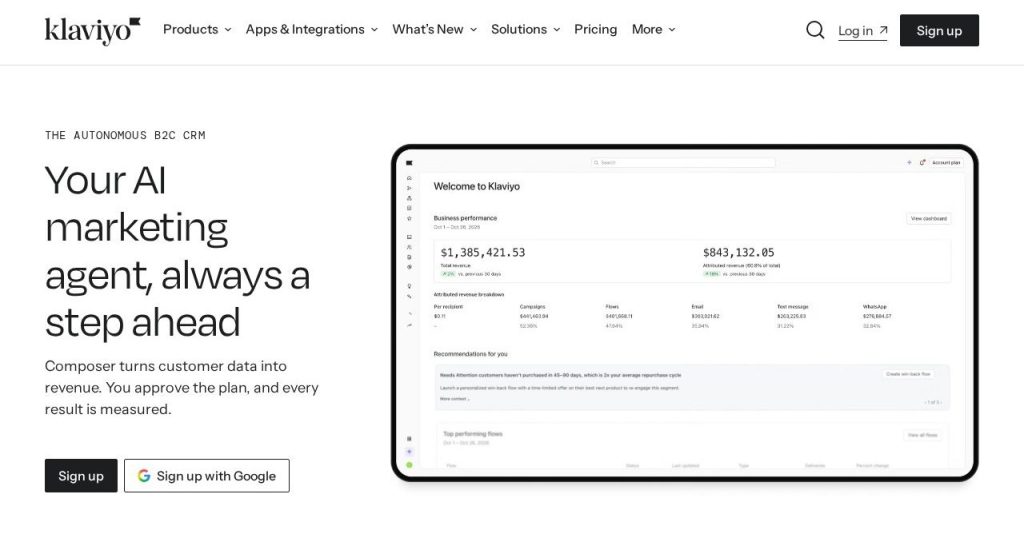
Klaviyo is an email and SMS platform built for online stores. It pulls in orders, browsing and product data from your store, so you can segment people by what they bought and trigger flows like abandoned cart, browse abandonment and win-back. Its Email plan starts at $20 a month for 500 active profiles and 5,000 emails.
A small Shopify store selling candles could set up a welcome series, an abandoned cart flow and a “buy again in 60 days” reminder on the free plan, then move to Email at $45 a month once its list passes 1,000 active profiles.
Key Capabilities
- Ecommerce flows: Pre-built abandoned cart, browse abandonment, post-purchase and win-back flows, available on every plan.
- Composer AI agent: Plans campaigns and flows from your data, with $5 of usage included each month on Free, Email and Marketing.
- Predictive analytics: Predicted lifetime value and churn risk once you have 500+ customers with orders and 180 days of history.
- SMS and reviews: Text messages and product reviews in the same account, with small free allowances.
- Deep Shopify sync: Products, orders, Shopify Markets and local catalogs flow straight into segments.
Pros
- Best-in-class flows for online stores
- Flows included even on the free plan
- Charges only for active profiles, not your whole list
- Free Mailchimp import with an API key
Cons
- Costs climb quickly as your list grows
- No free trial of paid plans
- Free plan email support ends after 60 days
- More to learn than Mailchimp
Plans & Pricing
- Free: $0/month. 250 active profiles, 500 emails a month, $5 of mobile messages and $5 of Composer usage.
- Email: $20/month for 500 active profiles and 5,000 emails (billed monthly). $45 at 1,500 profiles, $100 at 5,000.
- Marketing: $25/month for 500 active profiles (billed monthly). Adds social marketing, Customer Hub and unlimited review orders. First month $1 for a limited time.
- Custom: Custom pricing (contact sales) for 150,000+ profiles.
- Billing: Monthly only; no annual plan or free trial.
Mailchimp: Overview
Best for: Service businesses, creators and local shops that mostly send newsletters and simple automations
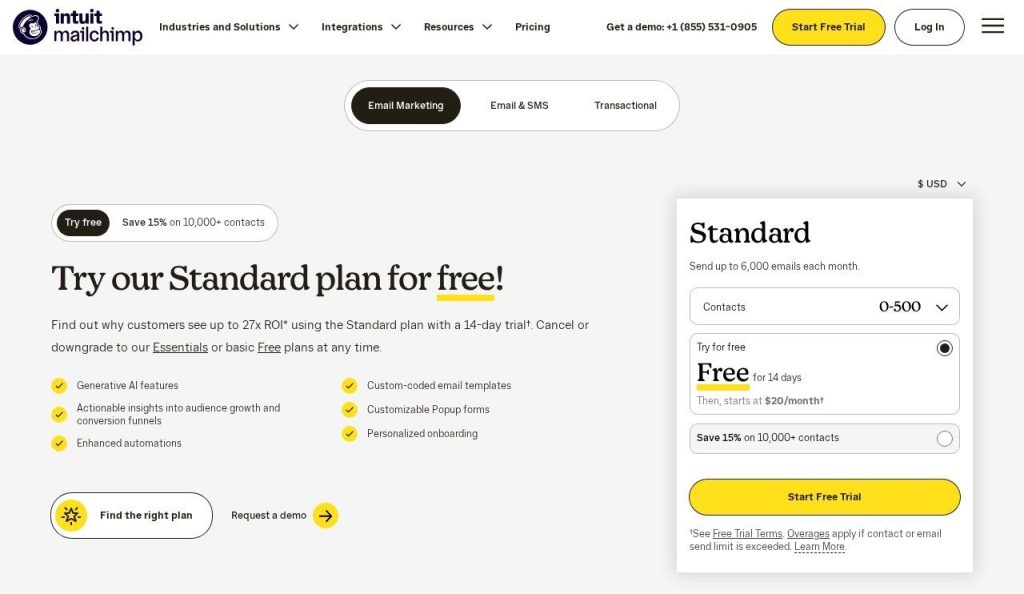
Mailchimp, owned by Intuit, is one of the best-known email marketing tools. You get a drag-and-drop email builder, landing pages, signup forms and customer journeys, with more than 300 integrations. Paid plans start at $13 a month for 500 contacts, and Essentials and Standard come with a 14-day free trial.
A 3-person accounting firm could send a monthly newsletter, welcome every new client with a 3-email journey and use AI to draft subject lines, all on the $20 Standard plan.
Key Capabilities
- Email builder and templates: Drag-and-drop editor with ready-made templates and custom-coded templates on Standard.
- Customer journeys: Up to 200 automation flows on Standard and Premium, with a simpler 4-step limit on Essentials.
- Generative AI: AI writing help and predictive segments on Standard and Premium at no extra cost.
- Team seats: 3 users on Essentials, 5 on Standard and unlimited on Premium.
- SMS add-on: Text marketing from $20 a month on Essentials and above.
Pros
- Cheapest paid plan of the two
- Easier for beginners
- 14-day free trial of Essentials and Standard
- Phone and priority support on Premium
Cons
- Free plan has no automation flows
- Unsubscribed contacts still count toward your limit
- Store data and ecommerce reports are less deep than Klaviyo’s
- Premium jumps to $350 a month
Plans & Pricing
- Free: $0/month. 250 contacts, 500 emails a month (250 a day), 1 user, no automation flows.
- Essentials: $13/month for 500 contacts (billed monthly). Sends up to 10x your contacts, 3 users, 14-day free trial.
- Standard: $20/month for 500 contacts (billed monthly). 6,000 emails a month, 5 users, up to 200 flows, generative AI, 14-day free trial.
- Premium: $350/month for 10,000 contacts (billed monthly). Unlimited users, phone and priority support.
- Annual billing: Only through sales for larger lists; 10,000+ contacts can save 15% on the first 12 months.
Pricing: Klaviyo vs Mailchimp
Mailchimp is cheaper at every small list size we could check. As of November 2026, Mailchimp Essentials costs $13 a month for 500 contacts and Standard costs $20, while Klaviyo Email costs $20 and Klaviyo Marketing costs $25 for 500 active profiles.
- Just starting (under 250 contacts): Both are free, but only Klaviyo’s free plan includes automation flows.
- 500 contacts with automations: Mailchimp Standard costs $20 a month. Klaviyo Email also costs $20.
- 500 contacts, basic newsletters: Mailchimp Essentials costs $13. Klaviyo has nothing below $20.
- Growing to 5,000 profiles: Klaviyo Email costs $100 a month. Check Mailchimp’s slider for your exact list size, since prices rise in tiers.
One detail can flip the math. Klaviyo bills only for active profiles you can email, while Mailchimp counts unsubscribed and non-subscribed contacts in your audience too, so clean your Mailchimp list often.
Winner: Mailchimp, because its paid plans start lower and include a 14-day free trial.
Ease of Use
Mailchimp is the easier tool for a first-time sender. The editor, templates and setup flow are built for someone who has never sent a campaign, and reviewers on Capterra often praise how quickly they learn it.
Klaviyo is not hard, but it assumes you think in segments, flows and store data. That power is the point for an online store, yet a consultant or a café may find more settings than they need.
Winner: Mailchimp, because a non-technical owner can send a good-looking newsletter on day one.
AI Features
Klaviyo goes further with AI. Its Composer agent can plan campaigns and flows from your store data, Segments AI builds audiences from a plain-English request, and predictive analytics estimates each customer’s lifetime value and churn risk. Composer usage is credit based, with $5 included each month.
Mailchimp includes generative AI for writing emails and predictive segmentation on Standard and Premium, with no extra charge. Its newer Intuit Assist features are in beta. Free and Essentials users don’t get the generative AI tools.
Winner: Klaviyo, because its AI uses real order data to suggest who to email and when.
Automation and Segmentation
This is Klaviyo’s home turf. Flows are on every plan, including Free, and you can trigger them from store events like a started checkout, a viewed product or a first order. Segments can mix email behavior with purchase history, such as “bought twice, not in the last 90 days.”
Mailchimp’s free plan has no automation flows, and Essentials allows only up to 4 flow steps. Standard raises that to up to 200 flows and predictive segments, which is plenty for welcome series, birthday emails and follow-ups.
Winner: Klaviyo, because it offers deeper, store-aware automation from the very first plan.
Integrations
Klaviyo says it connects with more than 350 apps, and its Shopify integration is one of its biggest strengths. Product catalogs, orders and Shopify Markets data sync in, so recommendations and segments stay current.
Mailchimp lists 300+ integrations, including a Shopify app, WooCommerce, Square, Canva and the common CRMs. For a business that isn’t selling online, that list covers almost everything you’ll need.
Tie: Klaviyo is the stronger choice for ecommerce platforms, while Mailchimp covers a wider mix of everyday small business apps.
Free Plan, Trial and Support
Both free plans cap you at 250 contacts and 500 emails a month. Klaviyo’s is more useful, since it includes flows plus $5 of SMS and $5 of AI usage, and it adds email support for the first 60 days. Mailchimp’s free plan has no flows and email support for only the first 30 days.
Mailchimp wins on trials and phone help. Essentials and Standard come with a 14-day free trial, paid plans get 24/7 email and chat, and Premium adds phone support. Klaviyo has no trial, and its paid plans get 24/7 email support plus live chat 24 hours a day, 5 days a week.
Tie: Klaviyo has the better free plan, while Mailchimp lets you test paid features for free and offers phone support.
Which Should You Choose?
- If you sell products online, pick Klaviyo and start with its abandoned cart flow.
- If you’re a service business that sends a monthly newsletter, pick Mailchimp Essentials at $13 a month.
- If you want AI writing help and automations on a small budget, pick Mailchimp Standard at $20 a month.
- If your list is under 250 people and you want automation for free, pick Klaviyo’s free plan.
- If you plan to add SMS and product reviews, pick Klaviyo so it all lives in one account.
- If you have a team of 3 to 5 who need logins, pick Mailchimp, which states its seat limits clearly.
Not Sold on Either?
MailerLite, Brevo and Omnisend cost less and still cover newsletters and automation well. Compare them in our guide to the best AI email marketing tools, or see our list of the best Mailchimp alternatives.
FAQs
Is Klaviyo more expensive than Mailchimp?
Usually, yes. As of November 2026, Klaviyo Email costs $20 a month for 500 active profiles, while Mailchimp Essentials costs $13 and Standard costs $20 for 500 contacts. Klaviyo only bills for active profiles, which can narrow the gap if your list has many unsubscribes.
Is Klaviyo better than Mailchimp for Shopify?
For most Shopify stores, yes. Klaviyo syncs products, orders and Shopify Markets data, and its pre-built ecommerce flows and predicted lifetime value are built around that data.
Can I move from Mailchimp to Klaviyo?
Yes. Klaviyo has a built-in Mailchimp integration that imports contacts, subscription status, lists and 90 days of engagement data using an API key. Campaigns and drag-and-drop templates need to be rebuilt.
Does Klaviyo have a free plan?
Yes. Klaviyo’s free plan covers 250 active profiles and 500 emails a month, with flows, $5 of mobile messages and $5 of Composer AI usage included.
Which is easier for beginners, Klaviyo or Mailchimp?
Mailchimp is easier for beginners because its editor and setup are built for first-time senders. Klaviyo is more powerful but expects you to work with segments and store data.
Which is better for a small business, Klaviyo or Mailchimp?
Mailchimp suits most small businesses because it’s cheaper and simpler. Klaviyo is the better pick if you run an online store and want sales-driven automation.
Final Thoughts
Open a free account on both this week and send the same welcome email to 20 real subscribers. If you run a store, connect it to Klaviyo and build the abandoned cart flow; if not, start Mailchimp’s 14-day Standard trial and see how fast you get your first newsletter out.
Still comparing tools? See our picks for the best AI email marketing tools, or read about the best AI tools for ecommerce store owners.